:::: MENU ::::

Mechanical engineering blog | Rotary Dampers | Ball Bearings | One-Way Clutches | Torque Limiters

We are excited to announce that TOK will exhibit at the 29th Manufacturing World Japan at Tokyo Big Sight from June 20th to 22nd.
We will show our standard products like rotary dampers and bearings, and also our new developments SR2 and SRX! We are looking forward to having a discussion with you guys in E75-10!

Please check the following link:
Oil dampers have characteristics of temperature and speed dependence.

In general, the viscosity of liquid changes greatly with temperature. Especially the viscosity of oil changes markedly as temperature changes. The viscosity decreases as the temperature rises and the viscosity rises as it goes down. This phenomenon is called temperature dependence. The damper has the property that the torque changes with the difference in temperature. When the temperature is higher, the movement is going to be faster and when the temperature is lower, the movement is going to be slower. In other words, damper not affected by temperature can be said to be easy to use damper.

As an example, here is the graph of temperature characteristics TD14 rotary damper. At 23℃ the closing time is approx. 6.5 seconds, and at 40℃ the closing time is approx. 6 seconds, even at 0℃ it is 7.3 seconds. If the temperature goes up and the viscosity of oil drops, it gets faster but it does not go up much.


Also, as the speed goes up the torque increases and we call it speed dependence. The infinite angle damper takes torque with the shear resistance generated by agitating the oil, and this shear resistance increases in proportion to the speed.
This is a speed dependence graph of TD62. You will see that the torque increases as the speed increases. In other words, since it can not be set to the slow down speed assuming that the torque is not matched. When you choose dampers to work for the toilet seat covers, you should consider the speed dependence of the damper.


TOK Newsletter

TOK will provide ONLY subscribers with valuable technical information.

The newsletter will be delivered about once per month, If you would like to receive the newsletter from us, you can subscribe via our contact form.


Written by Mayu

TD27/28

PBT: Poly Butylene Terephthalate


PBT is tough, rigid and excellent in thermal aging 
resistance. 
In addition, the electrical characteristics are  
great in a wide temperature range, the water absorbency is low, and weather resistance and chemical resistance are well balanced.
(PBT is used for TD27/TD28, TD99 etc.)


PA: Polyamide

TD118

Polyamide has good mechanical properties, and it is 
resistant to tension, compression, bending and impact.
It is not easily damaged. It is also resistant to heat and can withstand more than 160 ℃ if glass fiber is added.
Moreover, chemical resistance and oil resistance are 
very strong and are not affected by machine oil.
(PA is used for TD118 and customized products.)


PC: Polycarbonate
TD88

Polycarbonate is a plastic with high transparency and 
impact resistance. Its heat resistant temperature is 
120 ℃- 130 ℃ and it has high resistance in resin.        Its cold resistance is around -100℃. Even among resins, it has considerable resistance at low temperature, and it is highly resistant even at high temperature range.
(PC is used for TD88, TD96 etc.)


POM: Polyacetal

TD14

Polyacetal is a material excellent in abrasion resistance and is self-lubricating. It is also excellent in mechanical  properties such as rigidity and toughness, and it has high temperature stability. 
POM is a material that is often used as a substitute for metals, especially due to these properties.
(POM is used for TD14.) 


PEI: Poly Ether Imide


Poly Ether Imide is a resin which is a combination of 
TD69
imide bond, imparting excellent heat resistance and 
strength, and also shows good processability.
It maintains mechanical strength even at high 
temperature and is excellent in flame retardancy.          It is also excellent in chemical resistance and strong 
against hot water.  In addition, it shows stable 
electrical characteristics and withstands 
ultraviolet rays and radiation.
(PEI is used for TD69)


PPS: Poly Phenylene Sulfide


Poly Phenylene Sulfide has excellent heat resistance, so it can be used for a long time at high temperature.  It’s also excellent in chemical resistance, so with oils and fats that dissolve PPS at 200 ° C or lower, there is no solvent. It is also excellent in flame retardancy, tensile strength and bending strength.  It has a feature that the shrinkage ratio during molding is small, so it has dimensional stability.
(PPS is used for customized products)


PES: Poly Ether Sulphone


It is also excellent in mechanical properties, and chemical properties such as hot water resistance, chemical resistance, flame retardancy, and molding processability. By taking advantage of these features it is used in a wide range of fields, such as electronic parts, automobiles, aircraft, medical care, food, paint and so on.
(PES is used for customized products)
  
Die Casting

Die casting is a casting method in which non-ferrous metals are melted in precision molds, and are poured at high speed and pressure using a die-casting machine and molded instantaneously. Die cast products have superior features such as high dimensional accuracy, excellent strength, and beautiful appearance.

ZDC: Zinc Die Casting


Zinc Die Casting, which has longer die life than
TD42
 aluminum die casting, is excellent in processability, 
so it is possible to manufacture parts with 
complicated shapes and parts with extremely high         dimensional accuracy. In addition, it enables 
advanced thinning, and because of its small 
draft angle, it is easy to mold after casting.
(Zinc Die Casting is used for TD42, TD112 etc.)


ADC: Aluminum Die Casting


It is economical and easy to cast, so aluminum die casting is a suitable method for mass production. It can produce products with high strength, excellent conductivity, thermal conductivity, excellent corrosion resistance and processability.
(Aluminum Die Casting is used for customized products)

TOK Newsletter

TOK will provide ONLY subscribers with valuable technical information.

The newsletter will be delivered about once per month, If you would like to receive the newsletter from us, you can subscribe via our contact form.


Written by Mayu

Damping Torque

Damping Torque is an instantaneous force that rotates an object around its rotary shaft(axis). Torque expresses the necessary force when moving an object. For example, when riding a bicycle, torque is the pushing force of the pedal. If you are pushing the pedal strongly, then the torque is greater.
The greater the force required to support the lid, and the greater the length of the object, the greater the objects torque will be.


Example calculation in case of toilet lid

Weight: 1kgf(=9.8N)
Length: 0.4m(gravity point=0.4m/2=0.2m)
9.8N×0.2m=1.96Nm
The following TOK rotary dampers would be suitable!

  TD69               TD99              TD100            TD112


TOK Newsletter

TOK will provide ONLY subscribers with valuable technical information.

The newsletter will be delivered about once per month, If you would like to receive the newsletter from us, you can subscribe via our contact form.


Written by Mayu
There are mainly 3 ways to generate torque of dampers.
1.       Pressure: it moves like syringe
2.       Sliding Resistance: friction movement
3.       Shear Resistance: it moves like scissors

They are used for the following types of dampers.
1.       Pressure → Partial rotation and Continuous rotation angle damper
2.       Sliding Resistance → Friction damper
3.       Shear Resistance → Partial rotation angle damper

Here is the inside of housing
Partial rotation angle damper

Continuous rotation angle damper

TOK Newsletter

TOK will provide ONLY subscribers with valuable technical information.

The newsletter will be delivered about once per month, If you would like to receive the newsletter from us, you can subscribe via our contact form.


Written by Mayu
TOK rotary dampers are mostly filled with silicone oil.

Silicone oil is colorless liquid and the most versatile product among silicone products. The silicone oil has beneficial effect in heat resistance, cold resistance and electrical quality. It also has different interface properties, and has excellent characteristics not found in mineral oil, animal and vegetable oils and various synthetic oils. In addition, silicone oil has wide range of viscosity.

Therefore, it is used in a wide range of fields such as electric equipment, lubricating, heat and cold resistance, water resistance, paint resin, and fiber oil.

Silicone Oil

Damper with Silicone Oil


Using various viscosity oils, TOK can provide you with multiple torques of dampers as the customer's request.

TOK Newsletter

TOK will provide ONLY subscribers with valuable technical information.

The newsletter will be delivered about once per month, If you would like to receive the newsletter from us, you can subscribe via our contact form.


Written by Mayu
Rotary damper is the mechanical parts to buffer the impact of the lid closing / opening. Rotary damper is effective for consistent motion, soft closing / opening, improved safety, and makes a product luxurious.

We manufacture oil filled style rotary dampers and there are 2 types of rotary dampers: partial rotation angle type and continuous rotation angle type. Partial angled rotary damper has limited operation angle. e.g. 110° and 180°, etc. On the other hand, continuous rotation angle rotary damper rotates 360° without limit.
           

Partial rotation angle damper

Continuous rotation angle damper


Our rotary dampers are used in multiple applications such as kitchen, bath, furniture, automotive, and more.
The rotary damper is very important for our quality of life!

Application examples:

Sliding Screen Doors


Garbage Can


Blinds


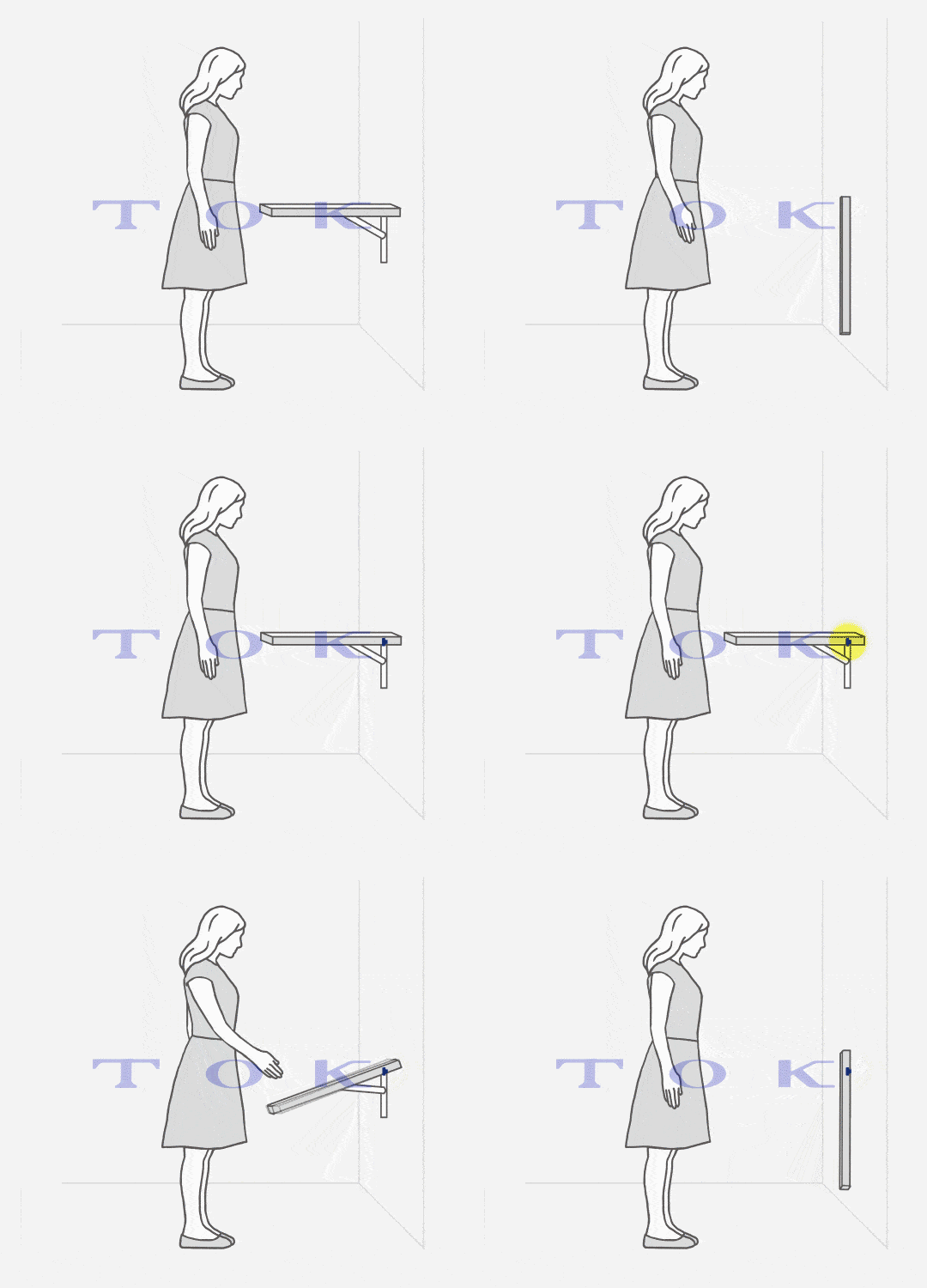
Wall Table


Console Box


Want to know how to install rotary dampers?

You can learn how to install our products on multiple applications.

TOK Newsletter

TOK will provide ONLY subscribers with valuable technical information.

The newsletter will be delivered about once per month, If you would like to receive the newsletter from us, you can subscribe via our contact form.